Create, Adapt, or Step Aside
+ OpenAI Snags Windsurf, Figma Finally Ships, and CEOs Warn: Adapt to AI or Be Left Behind!

Richard Bohus
May 09, 2025 • Estimated Reading Time: 11 minutes

Dear Readers,
Forget static content. AI is breathing life into collaborative creation, making it dynamic and interactive. From OpenAI's coding power-up to Figma's AI design and Higgsfield's next-gen video, the landscape is shifting fast. and your future job might depend on understanding it.
Top news
The Rise of Shareable Prompts: Dynamic Content is/will be Key
Over the past year, I've been increasingly fascinated by a trend: creators are openly sharing their AI prompts and they go viral all the time. At first, I wondered about the "why" behind giving away the "secret sauce." But it's become clear to me that this isn't just a fleeting fad; it’s an evolution of content that AI uniquely enables. Instead of creators just providing static information, sharing prompts turns content into a dynamic, two-way street. It allows readers and viewers to actively engage, customize ideas for their own specific situations, and really "plug in their own mind," so to speak.
What's particularly exciting to me is how this fosters a culture of building upon each other's ideas. One shared prompt can spark a dozen new interpretations, each iteration evolving from the last. This collaborative evolution also makes me think about the future of Intellectual property, it’s bound to become an increasingly interesting and complex landscape as original prompts spawn countless unique creations.
For me, the core realization is that the real power, the real engine for connection, isn't solely in the final, polished piece anymore. It's in sharing the prompt, the very essence of creation that invites this collaborative journey.
My Plans: Prompting and Guiding
Inspired by this, I'm going to start sharing more of my Midjourney prompts. I'm even working on a custom prompter based on my personal style. Think of it as a way to give you the keys to my process.
I've been building a Midjourney starter guide, but I'm considering turning it into a custom GPT version. Something that acts more like a tutor, guiding you step-by-step. I will be experimenting with it. Of course, it'll need a proper curriculum and memory to make it truly effective, but that’s for the future if it takes off.
What do you think? Are you noticing this trend? I believe dynamic content is the future, and I'm looking forward to exploring it with you all.
Beyond Tools: AI Agents, Output, & Our New Reality
It’s funny, isn't it? Just a short while ago, it felt like AI was this sci-fi concept for some, or maybe just another overhyped tech trend for others. I bet a few folks were even secretly (or not so secretly) hoping it would just be a passing phase. But lately, especially with some of the bombshells dropped by CEOs like Micha Kaufman at Fiverr and Tobi Lütke over at Shopify in the last month or so, it feels like the collective penny has dropped. Hard.
"AI is coming for your jobs. Heck, it's coming for my job too."
Kaufman basically sent out a flare gun warning to his team and pretty much everyone else by extension. He wasn't mincing words. His take? If you're not becoming "exceptional" by mastering these AI tools, you're looking at a career change, and soon. He even pointed out that for many, "Google is dead" and that fluency in LLMs is the new baseline. oof.
Then you've got Lütke at Shopify, who essentially told his teams that if they want more people, they first need to prove why AI can't do the job. Think about that – AI is no longer just a tool to try, it's the default, and using it effectively is now a "fundamental expectation" tied to performance reviews. He’s talking about AI helping people achieve "100X the work."
and it’s not just these guys. Demis Hassabis, the CEO of Google DeepMind, was recently telling students at Cambridge that "change will be the only constant in the next decade." figuring out student life can be tough, especially when it's hard to see where you're going and opportunities feel like they're vanishing in front of your eyes. He's urging everyone, especially those just starting out, to get good at "learning to learn" and to really focus on adaptability. I feel like learning to learn with AI is more valid. Forget just chasing the latest shiny tech trend, he emphasizes mastering foundational knowledge and getting your hands dirty experimenting with all these open-source tools. That’s how you stay ahead, not by memorizing today’s hot skill, but by building the capacity to absorb tomorrow’s.
even my friends who were always skeptical about how fast AI would change, those I've had debates with about the exponential growth curve… seeing them come around? It's a scary validation! Like, "I told you so," but in a good way, right? The shift from "AI won't really impact things that much" to "Whoa, this is happening now" is so tangible.
This is where it gets really interesting for me, and it echoes some of what Andrej Karpathy has been hinting at. We're moving beyond just having "tools." Soon, it might be less about us fiddling with complex software and more about us managing outputs through AI agents. Imagine just telling an agent what you need, and it not only does the task but maybe even spins up a custom dashboard or UI on the fly, just for that specific need. No more one-size-fits-all software, but dynamic, intelligent interfaces generated as required. Karpathy talks about AI agents being a huge step, and a simple, clean UI for these agents could be as revolutionary as ChatGPT was for LLMs.
It's a massive shift from "AI might help" to "AI is the new reality, adapt or get left behind." The output is undeniable, and the future probably looks a lot like us orchestrating a team of AI agents from a central, maybe even self-generating, control panel. Wild, right? But it’s happening now.
What do you think about these CEO takes? Are you seeing this shift happen around you too?
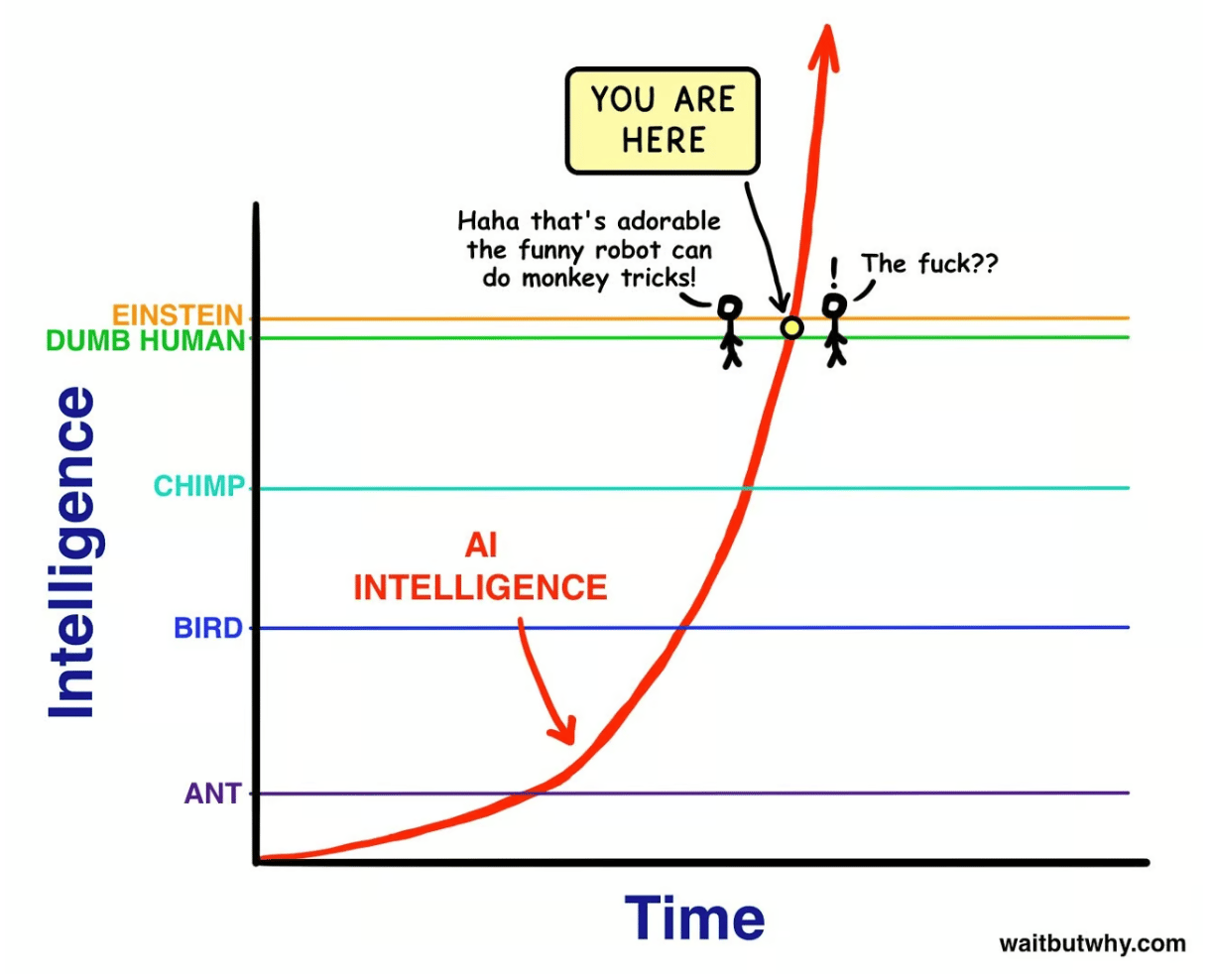
source: waitbutwhy.com
BYGEN Updates
Alright, here's what's currently on my radar at BYGEN:
Midjourney v7 Guide in the Works: I'm creating a new beginner's guide specifically for Midjourney v7. With many existing guides focusing on older versions, this should be a valuable resource. It will be a lead magnet for new newsletter sign-ups, and current subscribers will receive it as well.
Custom Midjourney Prompter: I’ve been experimenting with custom GPTs to enhance MJ prompts, optimizing for the best possible outputs. I'll be sharing this tool soon and would appreciate your feedback.
AI News Aggregator Project: To keep up with the rapid pace of AI news, I'm collaborating on an aggregator that filters and distills key information. This will be used for updates across X, LinkedIn, and this newsletter.
Website Development Progress: I'm actively working on the BYGEN website, including the implementation of new tools and optimizing user funnels. More details will be shared as development progresses.
AIgorithm Exhibition Artwork: I'm pleased to announce that 3 of my artworks will be featured at the AIgorithm Exhibition in Ho Chi Minh City from May 22nd to the end of June.
📡 AI News worth knowing
OPENAI
🤖 OpenAI's $3B Gambit with Windsurf: Shaking Up AI Coding & the VS Code Realm

Source: bygen
The world of artificial intelligence and software development is witnessing a seismic shift, with major players making bold moves to define the future of how code is created. OpenAI, a leading force in AI research and deployment, has recently made a monumental $3 billion acquisition of Windsurf (formerly Codeium), an AI-assisted coding tool. This move, coupled with the meteoric rise and hefty valuation of AI-centric code editors like Cursor, signals a fierce battle for the developer desktop and the very nature of software engineering. This article delves into OpenAI's strategic play, the burgeoning market of AI IDEs, and the evolving landscape for VS Code and its innovative offshoots.
OpenAI's Strategic Masterstroke: The Windsurf Acquisition
OpenAI's acquisition of Windsurf for a reported $3 billion is its largest to date and speaks volumes about its ambitions in the AI-powered software development market.
What is Windsurf? Windsurf, which was known as Codeium, is a platform that provides AI-assisted coding tools. These tools integrate with integrated development environments (IDEs) to offer capabilities like code completion, natural language to code generation, and bug detection, aiming to significantly boost developer productivity.
Why is this a big deal?
Competitive Positioning: The acquisition directly strengthens ChatGPT's coding functionalities and positions OpenAI to compete more effectively against established players like Microsoft's GitHub Copilot and other rising AI coding assistants, including Anysphere's Cursor.
The Data Play: Many analysts believe a core driver for this acquisition is the vast amount of training data generated by users interacting with AI-assisted IDEs. This data is invaluable for training more sophisticated future coding agents, potentially capable of handling even more complex development tasks autonomously.
Ecosystem Control: This move signals a strategic shift for OpenAI, moving beyond just creating powerful AI models to controlling more of the ecosystem where these models are applied. By owning a popular coding assistant, OpenAI gains direct access to developers and their workflows.
Fueling Agentic AI: The acquisition aligns with the industry's push towards "agentic AI" – AI systems that can take on complex tasks with greater autonomy. Coding agents are seen as a significant future market.
The Ascent of AI-Native Code Editors: Cursor's Sky-High Valuation
Parallel to OpenAI's acquisition, AI-native code editors like Cursor are also making significant waves. Anysphere, the company behind Cursor, recently secured a staggering $900 million in funding, catapulting its valuation to around $9 billion.
What is Cursor? Cursor is an AI-first code editor built as a fork of the popular open-source Visual Studio Code (VS Code). It's designed from the ground up to deeply integrate AI capabilities into the coding experience, offering features that go beyond what typical VS Code extensions can provide.
The Appeal: For developers, Cursor offers a highly integrated AI experience, aiming to make coding faster, more intuitive, and more powerful by embedding AI assistance directly into the editor's core functionalities.
What Could Be Next in the AI Coding Arena?
The convergence of powerful AI models, substantial investment, and the drive for developer productivity is reshaping the coding landscape:
Intensified Competition: The battle for developers' preferred coding environment will only heat up. We can expect more features, better AI integration, and potentially more aggressive strategies from all players.
The Rise of Sophisticated AI Agents: The focus on acquiring user interaction data strongly suggests that the development of highly autonomous AI coding agents is a key long-term goal. These agents could handle everything from boilerplate code generation to complex debugging and even architectural suggestions.
Shifting Developer Workflows: As AI tools become more capable, the daily tasks and skills required of human developers will continue to evolve, with a greater emphasis on high-level design, problem-solving, and AI collaboration.
The VS Code Ecosystem Under Pressure: Microsoft's moves to protect its extension ecosystem could either stifle innovation in forks or spur the development of more robust open-source alternatives. The future likely holds a mix of both.
Further Insight: A Word from the Inside
For those keen to understand the thinking behind some of these AI coding advancements, the Y Combinator podcast recently featured an insightful episode with the CEO of Windsurf. It covers topics like betting on AI agents, the rapid pivots required in the AI space, and the future of coding. You can often find these talks on the YC Startup Library or their YouTube channel. A particularly relevant one is titled: "Windsurf CEO: Betting On AI Agents, Pivoting In 48 Hours, And The Future of Coding."
The journey of AI in software development is just beginning. OpenAI's acquisition of Windsurf and the impressive growth of tools like Cursor are clear indicators that the way we build software is on the cusp of a profound transformation, bringing both immense opportunities and new challenges for the global developer community.
💻 Google's Gemini 2.5 Pro Flexes New Coding Muscles
Source: Google
Google has rolled out an upgraded Gemini 2.5 Pro, showcasing significant enhancements in its AI-driven coding capabilities. This latest iteration, released ahead of the anticipated Google I/O conference, is already making waves by topping leaderboards and demonstrating advanced proficiency in complex programming tasks.
Key Enhancements & Performance:
Advanced Coding Prowess: The updated Gemini 2.5 Pro exhibits major improvements in generating, transforming, and editing code. It shows particular strength in building interactive web applications and creating sophisticated "agentic" workflows, where AI can perform multi-step programming tasks.
Benchmark Highlights:
It has climbed to the #1 spot on the WebDev Arena leaderboard, a benchmark measuring human preference for AI-generated web applications.
The model scores a strong 63.8% on SWE-Bench Verified, an industry standard for evaluating agentic coding capabilities.
It also performs well on benchmarks like LiveCodeBench (70.4%) for code generation and Aider Polyglot (74.0%) for code editing.
Beyond Coding: Gemini 2.5 Pro isn't just about code. It boasts a massive 1 million token context window (with plans to expand to 2 million), enabling it to process and understand vast amounts of information. It also features advanced multimodal processing (handling text, images, audio, and video) and enhanced reasoning abilities, adopting a "thinking model" approach for improved accuracy.
Why it matters:
The advancements in Gemini 2.5 Pro signal a significant step forward in AI-assisted software development. Developers gain access to a more powerful tool capable of tackling a wider range of programming challenges, potentially speeding up development cycles and enabling new types of applications. This release further intensifies the competitive landscape among leading AI models, pushing the boundaries of what AI can achieve in the realm of coding and beyond. The model is accessible through Google AI Studio, Vertex AI, and for Gemini Advanced users.
Creative AI News
Figma
🎉 Figma Config 2025: A Total Game Changer, They Nailed It!
Source: Figma
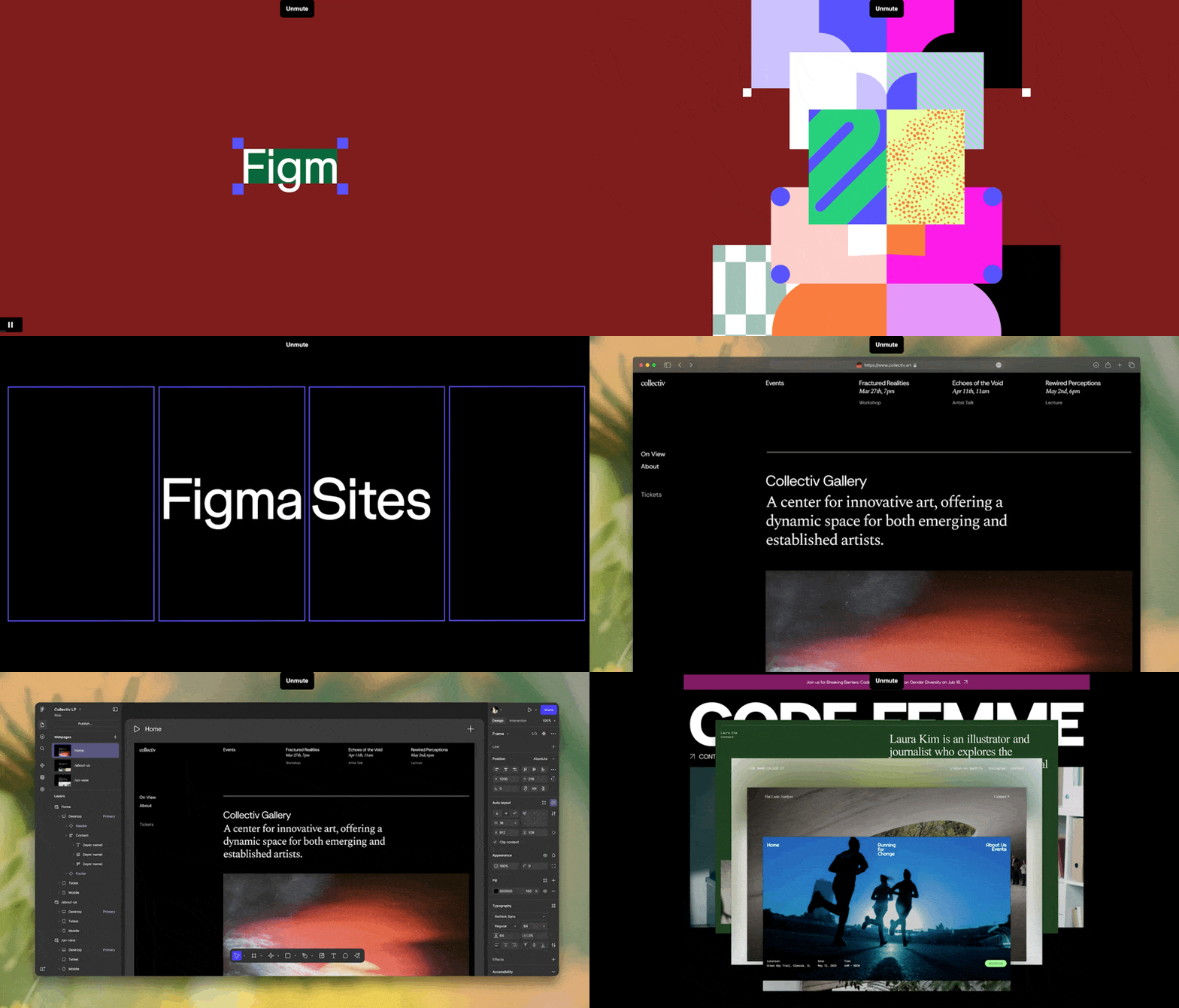
Figma's annual Config event happened this week, wasn't just about new features, it marked a significant shift, solidifying Figma's place as the ultimate all-in-one platform for creators. As a huge Figma fan who organizes all design and creative work within it, the announcements were astounding. It's clear Figma is aiming to be the single source of truth for design, development, and beyond. They absolutely nailed it, and the implications are massive!
Key Announcements That Have Everyone Talking:
Figma Sites: Directly build and publish responsive websites from Figma. No more handoffs to platforms like Webflow or Framer, design and launch, all in one place.
Figma Make: An AI-powered, prompt-to-code tool. Describe what you want, and Figma Make generates functional prototypes and even web apps. This is a direct challenge to emerging AI coding assistants and low-code tools.
Figma Draw: Enhanced vector editing tools, brushes, and effects are here, making Figma a serious contender in the illustration space, traditionally dominated by tools like Illustrator.
Figma Buzz: AI-assisted content creation for marketing teams, enabling scalable, on-brand asset generation.
AI Woven Everywhere: Beyond specific tools, AI is being deeply integrated across the Figma suite to speed up workflows, from text suggestions to image editing.
Grid: A new auto layout option to create complex, two-dimensional responsive layouts with ease.
Why This Is So Exciting (and Disruptive):
This is more than just an update, it's a revolution. Figma is consolidating the entire workflow:
Web Development Disrupted: With Figma Sites, dedicated web builders like Webflow and Framer have serious new competition.
Design Space Evolution: Figma Draw steps firmly onto the turf of specialized illustration software.
Coding and Prototyping Redefined: Figma Make, with its AI-driven code generation, looks set to challenge tools like Bolt, Lovable, v0, and even aspects of platforms like Replit.
Higgsfield
🎬 Higgsfield AI Supercharges Video Creation

Source: Higgsfield
Higgsfield AI is rapidly evolving its AI video generation platform, rolling out significant updates that give creators unprecedented control and creative firepower. Recent enhancements focus on precise start and end frame definition, a dazzling array of new visual effects (VFX), and the innovative ability to mix multiple camera motions for truly dynamic results.
It is the best video model on the market in my opinion. Prompt coherence and templates are just better than other models.
Key Updates & Features:
Precise Scene Crafting with Start & End Frames: Creators can now define a clear narrative path by uploading a starting image and an optional ending frame. Higgsfield AI then masterfully generates the video sequence, bridging the two visuals. This feature, highlighted around early May 2025, allows for more structured and intentional storytelling.
Explosive New Visual Effects: The platform has significantly expanded its library of built-in VFX. Users can now easily incorporate eye-catching effects such as "Bullet Time," "Disintegration," "Explosions," "Set on Fire," "Melting," and "Thunder God," among over 50-60 cinematic effects and styles.
Revolutionary "Higgsfield Mix" for Combined Motions: Perhaps one of the most exciting new capabilities is "Higgsfield Mix." This allows for the combination of multiple camera movements and effects within a single shot. Imagine blending a "Crash Zoom" with a "Face Punch POV" or a "Car Chasing" scene that culminates in a "Building Explosion." This opens up a new realm of complex and professional-looking video sequences that were previously difficult or impossible to achieve with AI.
Continued Focus on Cinematic Control: Alongside these, Higgsfield continues to enhance its core strength: offering a vast range of pre-set cinematic camera movements like dolly shots, FPV drone-style footage, 360 orbits, and arcs. The recent "Turbo" model also ensures faster generation speeds for quicker iteration.
Why it matters:
These updates solidify Higgsfield AI's position as a powerful tool for filmmakers, marketers, and content creators seeking to produce high-quality, cinematic videos with a high degree of control and creative flexibility. The ability to define start and end points provides better narrative structure, while the expanded effects and motion mixing capabilities unlock new levels of visual dynamism and sophistication, all within an increasingly accessible AI-powered platform. This means more creators can bring complex visual ideas to life without needing extensive traditional filmmaking resources.
Other News
Sam Altman says AI may be the biggest technological shift in human history, and even he doesn't know where it’s going. He testified in front of Congress on AI competition
Absolute Zero Reasoner - an AI that autonomously learns reasoning in math and coding through self-play without external data, achieving state-of-the-art performance but raising safety concerns due to unsettling chain-of-thought outputs.
How People Use Generative AI Study by Harvard - People love AIs as companions
Claude MCP Agents are revolutionizing the way we work with over 5,000 apps at our fingertips. Gamechanging technology for all.
Elon raising money for xAI at a $120 billion valuation - He buys X 2 years ago for $44 billion, then immediately turns around, takes the data, and starts an AI company that's now worth 3 times that
Stripe accelerates the utility of AI and stablecoins - Stripe unveils the world's first AI foundation model for payments. Plus hold a stablecoin balance. Send and receive funds with fiat and crypto rails.
QUICK HITS
Trending tools
Higgsfield Effects - Try out the news Hollywood grade effects
Figma’s - New features are now live in Figma
New Comfy look and integrations - One platform, 11 models, 65 nodes, all at once. Chain the APIs with open models and workflows
LTX Studio announced the release of LTX Video-13B, open-source AI video model.
Best Insights / Tutorials
COMMUNITY
🏆 Artist of the Week
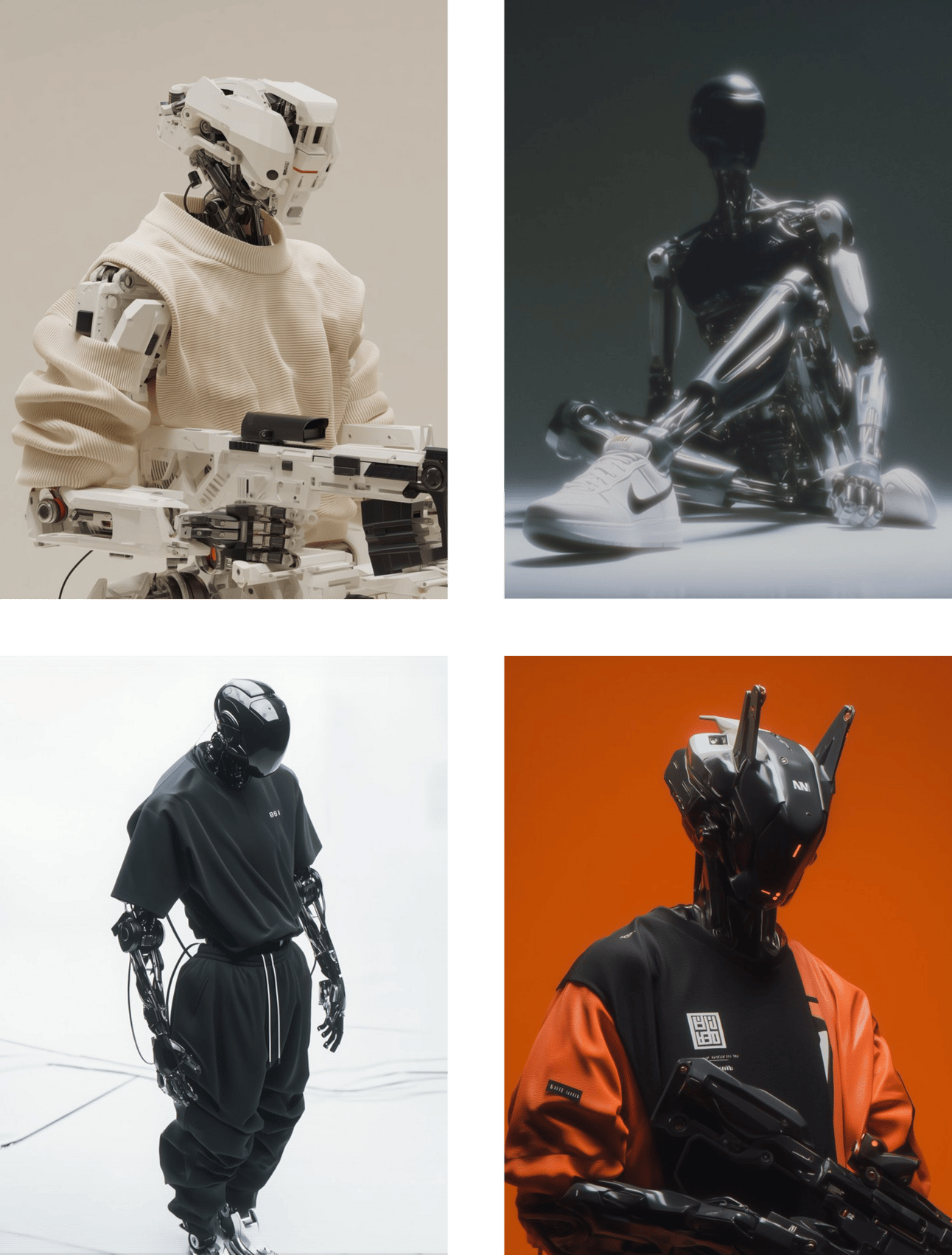
Ink🌉 About: AI Designer for @OresCollective I’ve always loved his minimal robot art, he’s been incredibly consistent with his unique style. Definitely an underrated artist, imo. 📍 Ho Chi Minh City, Vietnam 🌐 Socials: Follow him on X |
See you soon,
R from BYGEN
Want to work with us?
We build autonomous AI systems that scale your business. Let's talk.